Customs Charges in Ireland: How Much & How to Pay [2026]
How much are customs charges in Ireland? Import duty, VAT, and carrier fees explained — plus how to pay customs on packages to Ireland.
July 13, 2026
Customs charges in Ireland are the import duty, VAT, and carrier clearance fees applied to goods entering the country. For parcels under €150 from outside the EU, you'll pay a flat €3 duty per item type plus VAT on top; above €150, percentage duty rates apply based on the product's HS code. Since Brexit, Irish consumers and businesses importing goods from the UK have found themselves facing these charges that simply didn't apply before. Understanding how Irish customs charges work is essential for keeping your customers happy and your checkout conversion rates healthy.
Why Irish Customs Charges Have Changed
Before Brexit, goods shipped between the UK and Ireland moved freely under EU single market rules. There were no customs declarations, no import duties, and no border checks. That changed on 1 January 2021, when the UK left the EU customs union. Overnight, goods arriving in Ireland from the UK became subject to the same customs procedures as shipments from any non-EU country.
The result has been a massive shift in consumer awareness. Irish shoppers who previously bought from UK retailers without a second thought are now routinely encountering import duty bills, VAT charges, and carrier handling fees on everything from clothing to electronics.
For e-commerce merchants, this represents both a challenge and an opportunity. Customers who receive unexpected customs bills at delivery are more likely to refuse shipments, leave negative reviews, and abandon future purchases. But merchants who proactively communicate Irish customs charges at checkout can build trust and win loyal customers in a market where transparency is still rare.
How Irish Import Duties Work
Ireland is an EU member state, so it follows the EU's Common External Tariff. Import duty rates are determined by the HS code (Harmonized System code) assigned to each product, and the rates are published in the EU's TARIC database. Every product category has its own duty rate, which can range from 0% to over 20% depending on the type of goods.
Key factors that determine Irish import duty rates include:
- Product classification — The HS code determines the base duty rate. For example, clothing typically faces 12% duty, while many electronics are rated at 0%.
- Country of origin — The EU has trade agreements with many countries that reduce or eliminate duties. However, goods manufactured in the UK and shipped to Ireland generally do not qualify for preferential rates unless they meet specific rules of origin under the EU-UK Trade and Cooperation Agreement.
- Declared value — Duty is calculated as a percentage of the customs value, which is the transaction value of the goods plus shipping and insurance costs.
The duty is calculated on the combined value of the goods and the shipping cost. This means a €100 product with €15 shipping and a 12% duty rate would incur €13.80 in import duty.
Irish VAT on Imports
On top of import duties, Ireland charges Value Added Tax (VAT) on nearly all imported goods. The standard Irish VAT rate is 23%, and it's applied to the total of the product value, shipping cost, and any duty charged. This layered calculation often catches first-time importers off guard.
Using the example above — a €100 product with €15 shipping and €13.80 in duty — the VAT calculation would be: (€100 + €15 + €13.80) × 23% = €29.63. That means the customer pays €29.63 in VAT on top of the €13.80 in duty, bringing total customs charges to €43.43 on a €115 purchase.
Ireland does apply reduced VAT rates to certain categories of goods:
- 13.5% — Applies to items like children's clothing and footwear, certain food products, and some health-related goods.
- 9% — Applies to e-books, newspapers, and certain tourism-related services.
- 0% — Applies to basic groceries, certain medical supplies, and items covered by specific exemptions.
For most e-commerce shipments, the 23% standard rate applies. Merchants using an Irish import duty calculator or a landed cost tool should ensure their VAT calculations account for the correct product category to avoid underestimating costs.
Ireland's De Minimis Threshold
The EU's de minimis rules determine when import duties and VAT apply to incoming shipments. Understanding them is critical for calculating Irish customs charges correctly:
- Duty: €3 flat fee — The old €150 duty exemption ended on 1 July 2026. Parcels under €150 from outside the EU now pay a flat €3 duty per item type — a temporary measure until the EU customs data hub launches around 2028. A €120 order shipped from the UK now pays €3 duty instead of nothing.
- VAT: €0 — There is no VAT exemption for imported goods. VAT applies to all commercial shipments regardless of value. Even a €10 item shipped from outside the EU will owe Irish VAT at the applicable rate.
This is a crucial distinction for merchants to communicate. While low- value orders dodge the percentage duty, they still owe the flat €3 duty and always owe VAT. For a €50 order at the standard 23% rate, that's €3 in duty plus about €12.20 in VAT — a significant surprise for customers who assumed small orders were exempt from all charges.
It's also worth noting that the flat €3 applies per item type (tariff category), not as a percentage of the goods' value — the same €3 applies whether the parcel is worth €10 or €150. VAT, meanwhile, is calculated on the full landed cost including shipping, the goods value, and any applicable duty. Genuine gifts between private individuals under €45 remain exempt from duty and VAT.
How to Offer Transparent Pricing to Irish Customers
The merchants winning in the Irish market are the ones making customs charges visible before the customer completes their purchase. Here are the most effective strategies:
- Ship DDP (Delivered Duty Paid) — With DDP shipping, you collect all duties and taxes at checkout and remit them to Irish customs on the customer's behalf. The customer receives their package with zero additional charges at delivery. This eliminates surprise bills and dramatically reduces refused shipments.
- Show a landed cost estimate at checkout — Display a breakdown of product price, shipping, duty, and VAT before the customer completes their order. Shoppers who see the full cost upfront are more likely to convert than those who discover fees later.
- Use an accurate duty calculator — Generic estimates lead to overcharges or undercharges. A tool that classifies products with the correct HS code and applies the current EU tariff schedule ensures your estimates are precise. An Irish import tax calculator that accounts for Ireland's specific VAT rates and de minimis rules will give you reliable numbers.
- Communicate clearly on your shipping page — Add a section to your FAQ or shipping policy that explains how Irish customs charges work. Proactive communication builds trust and reduces support tickets from confused customers.
RateTell handles all of this automatically. It classifies products using AI-powered HS code matching, applies the correct EU tariff rates, and calculates Irish VAT at the appropriate rate — all in real time at checkout. Merchants can offer DDP shipping to Ireland with confidence that the numbers are accurate.
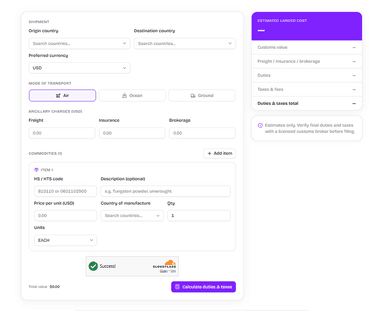
Try the free duty & tax calculator
Enter your product's HS code to see the exact Irish duty and 23% VAT it will owe.
Calculate duty & tax nowFrequently Asked Questions
How much are customs charges in Ireland?
For parcels under €150 from outside the EU, you'll pay a flat €3 duty per item type plus VAT — most goods at the standard 23% rate. For parcels above €150, percentage duty rates apply based on the product's HS code (up to 12% for clothing, for example), with VAT still charged on top. A €115 purchase (€100 goods plus €15 shipping) now pays the flat €3 duty plus 23% VAT on the €118 total — about €27.14 in VAT, or roughly €30.14 in customs charges.
Do I have to pay customs on parcels from the UK?
Yes. Since 1 January 2021, goods arriving from Great Britain are treated like shipments from any other non-EU country, so they can owe duty, VAT, and carrier handling fees. Parcels under €150 pay the flat €3 duty per item type, and VAT at 23% (or the relevant reduced rate) applies on top from the first euro.
Who collects customs charges on parcels to Ireland?
The courier or postal carrier — An Post, FedEx, DHL, UPS, and similar — pays the duty and VAT to customs on your behalf, then collects the amount from you before or at delivery. Expect a secure payment link by email or SMS, or a collection at the door. The bill includes the carrier's own clearance and advancement fees on top of the government charges.
What is the Irish VAT rate on imports?
The standard Irish VAT rate is 23%, and it applies to nearly all imported goods. It's calculated on the full landed cost — product value plus delivery plus any duty — so a €100 item with €15 shipping and the €3 flat duty incurs €27.14 in VAT. Reduced rates of 13.5% and 9% apply to items like children's clothing and e-books, with 0% on basic groceries.
Are there any customs exemptions in Ireland?
A few narrow ones. Genuine gifts between private individuals worth under €45 remain exempt from duty and VAT. The old €150 duty exemption for low-value parcels ended on 1 July 2026 — parcels under €150 now pay a flat €3 duty per item type instead. Commercial shipments never qualify for a VAT exemption, regardless of value.
Related guides: EU Import Duty · UK Import Duty · Customs Charges from the UK to Ireland · Ireland Import Duty & VAT Rates
Show duties and taxes at checkout to give your Irish customers transparent pricing. Start for free with RateTell.
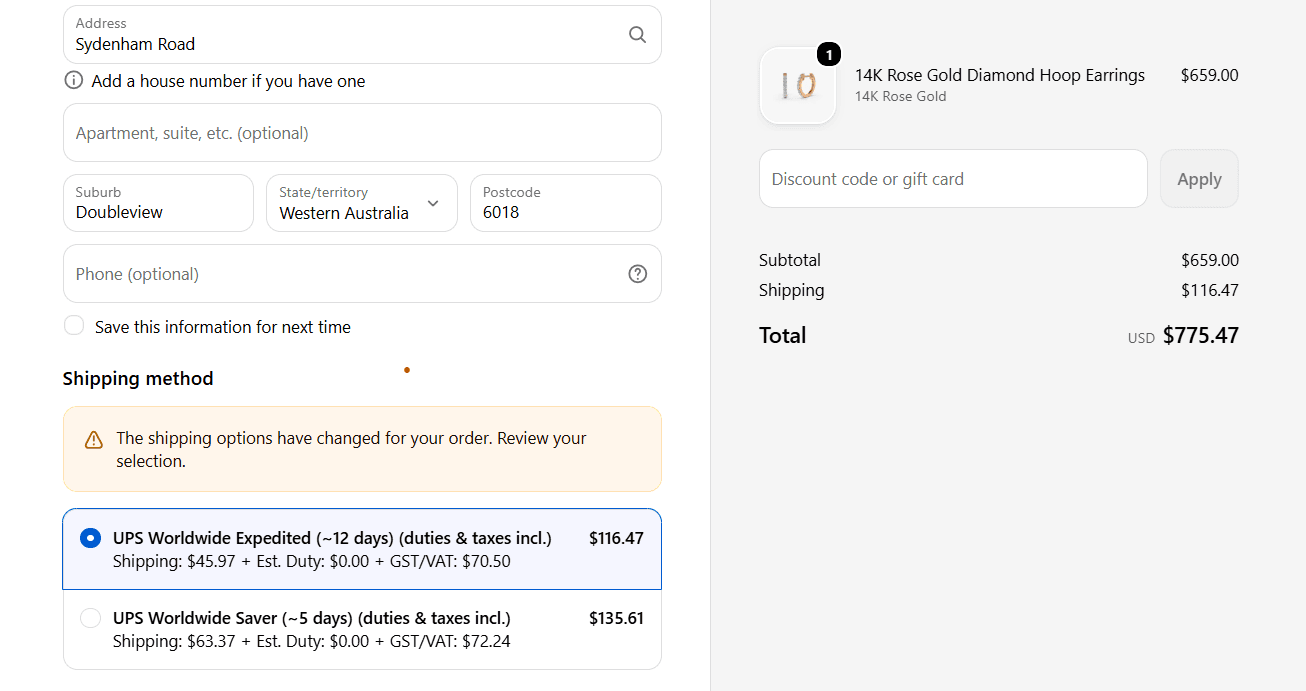
Show duties & taxes at checkout on Shopify
Selling to Irish customers? Show duty and 23% VAT at checkout so nothing is owed when the carrier arrives.
Install on ShopifyRateTell Team
RateTell helps Shopify merchants show estimated duties, taxes, and shipping at checkout. Start for free today.
Start for FreeRelated articles
Countries
Canadian Import Duties: Complete Guide for 2026
How Canadian import duties work — CBSA tariff schedules, duty rates, de minimis thresholds, and how to calculate duties for shipments to Canada.
Countries
EU Import Duty: Rates, VAT, and How to Pay [2026]
EU import duty explained: how the EU charges import duty and VAT, current rates, de minimis rules, and how to pay customs charges.
Countries
UK Import Duty & HMRC Rules: Merchant's Guide
How UK import duty and HMRC customs rules work. Covers duty rates, VAT, de minimis thresholds, and the UK Global Tariff for international Shopify merchants.