UK Import Duty & HMRC Rules: Merchant's Guide
How UK import duty and HMRC customs rules work. Covers duty rates, VAT, de minimis thresholds, and the UK Global Tariff for international Shopify merchants.
July 13, 2026
UK import duty is the customs tax HMRC charges on goods entering the country, set by the product's commodity code under the UK Global Tariff. Commercial shipments valued at £135 or less are exempt from duty, but 20% VAT applies to every commercial import regardless of value. Since leaving the EU single market in January 2021, every shipment entering the UK now crosses a customs border. Whether you're shipping fashion accessories from Turkey, electronics from Shenzhen, or skincare from South Korea, understanding UK import duty and HMRC customs rules is essential for accurate pricing and smooth deliveries.
How UK Import Duty Works
Post-Brexit, the UK operates its own customs regime independent of the European Union. The UK Global Tariff (UKGT) replaced the EU's TARIC system on 1 January 2021, setting duty rates for all goods entering Great Britain (England, Scotland, and Wales). Northern Ireland follows different rules under the Windsor Framework, which largely aligns with the EU customs code.
HMRC (Her Majesty's Revenue and Customs) administers all UK customs duties. Every product entering the UK must be classified with a commodity code — the UK's version of the Harmonized System (HS) code. These codes, typically 10 digits long, determine the applicable duty rate, any trade preference eligibility, and whether import licensing or other restrictions apply.
The UKGT maintains many of the same HS chapter structures used internationally, so a product's HS code is largely consistent between the US, EU, and UK at the 6-digit level. However, the national suffix digits differ, and the final duty rate can vary. Getting the commodity code right is critical — misclassification can lead to overpaying duties, shipment delays, or penalties from HMRC.
UK Duty Rates
The UKGT sets Most Favoured Nation (MFN) duty rates for goods entering from countries without a preferential trade agreement. Rates vary by product category, and many are slightly lower than the old EU Common External Tariff — the UK government simplified and reduced some tariffs as part of its independent trade policy. Here are common categories for ecommerce merchants:
- Clothing & textiles — 12% on most garments. Cotton and synthetic apparel typically falls in the 8–12% range.
- Electronics — 0% to 14%. Many consumer electronics (phones, laptops, tablets) enter at 0% under the Information Technology Agreement (ITA). Accessories and appliances can be higher.
- Footwear — 8% to 17%. Leather shoes face the highest rates; sports and synthetic footwear tend to sit at the lower end.
- Cosmetics & skincare — 0% to 6%. Most skincare products carry low duties; perfumes and essential oils can be higher.
- Home goods & furniture — 0% to 9%. Wooden furniture is often duty-free; upholstered items may reach 5–9%.
- Toys & games — 0% to 4.7%. Relatively low tariffs apply under WTO agreements.
The UK has signed free trade agreements with countries including Australia, Japan, New Zealand, and Singapore. Goods originating from these countries may qualify for reduced or zero duty rates, provided they meet rules of origin requirements and you can supply a valid proof of origin.
UK VAT on Imports
In addition to customs duty, imported goods are subject to Value Added Tax (VAT). The UK standard VAT rate is 20%, applied to the total value of the goods plus shipping costs and any import duty. This compounding effect means the effective tax burden is higher than the headline duty rate alone.
Some product categories qualify for reduced rates:
- 5% reduced rate — Applies to certain energy-saving materials, child car seats, and smoking cessation products.
- Zero rate (0%) — Most food and drink (not confectionery or catering), children's clothing, books, and newspapers are zero-rated.
For goods valued at £135 or less, the overseas seller is responsible for collecting UK VAT at the point of sale and reporting it through a UK VAT registration or via the Non-Established Taxable Person (NETP) scheme. For goods above £135, VAT is collected at the border by HMRC and typically paid by the customer before delivery.
UK De Minimis Thresholds
The UK applies two distinct de minimis thresholds that affect what customers pay:
- Duty threshold — £135 — Commercial shipments with a customs value of £135 or less are exempt from customs duty. This covers most low-to-mid value ecommerce orders. Duty only applies when the value exceeds £135.
- VAT threshold — £0 — Unlike the EU (which removed its €22 exemption in 2021), the UK has no VAT exemption for commercial imports. All imported goods, regardless of value, are subject to UK VAT.
- Gift exemption — £39 — Personal gifts valued under £39 are exempt from both duty and VAT. This applies only to genuine gifts between private individuals, not commercial shipments.
The £135 duty threshold is based on the intrinsic value of the goods (excluding shipping and insurance). However, VAT for consignments under £135 is calculated on the total value including shipping — a detail that catches many merchants off guard.
HMRC Customs Rules for Merchants
Every commercial shipment entering the UK requires a customs declaration. Since March 2024, all declarations must be submitted through HMRC's Customs Declaration Service (CDS), which replaced the older CHIEF system. The declaration must include the correct commodity code, goods value, country of origin, and any applicable preference codes.
Most merchants use a customs broker or freight forwarder to handle declarations on their behalf. The broker submits the CDS entry, calculates duties owed, and ensures compliance with HMRC requirements. Carriers like DHL, FedEx, and UPS typically offer brokerage services as part of their shipping packages.
Key compliance points for merchants:
- Commodity codes — You are legally responsible for correct classification, even when a broker files the declaration.
- Invoice accuracy — Commercial invoices must show the true transaction value, itemized by product. Undervaluing goods to reduce duty is a criminal offence under UK customs law.
- Proof of origin — To claim preferential rates under UK trade agreements, you need a valid statement on origin or supplier's declaration.
- UKCA marking — Certain product categories (electronics, toys, medical devices) require UKCA conformity marking to enter the UK market, separate from the EU's CE marking.
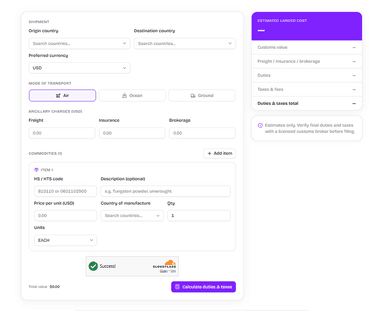
Try the free duty & tax calculator
Enter your product's HS code to see the exact UK duty and 20% VAT it will owe.
Calculate duty & tax nowFrequently Asked Questions
How much is UK import duty?
It depends on the product's commodity code under the UK Global Tariff. Common e-commerce ranges are 0-4.7% for toys, 0-14% for electronics, 8-12% for clothing, and 8-17% for footwear — and goods originating from countries with a UK trade agreement may qualify for reduced or zero rates.
What is the UK de minimis threshold?
The UK duty threshold is £135 — commercial shipments valued at £135 or less are exempt from customs duty, but VAT still applies on every commercial import regardless of value. Genuine gifts between private individuals are exempt up to £39.
Do I pay VAT on imports to the UK?
Yes — the standard UK VAT rate is 20% and it applies to all commercial imports, with no value exemption. On goods up to £135 the overseas seller collects VAT at checkout, while goods above £135 are assessed at the border and typically paid by the customer before delivery.
How do I pay UK import duty?
For shipments above £135, HMRC assesses the duty and VAT at the border and the carrier or courier usually collects it before delivery. If you file your own entries, you pay through HMRC's Customs Declaration Service (CDS), which has been mandatory for all declarations since March 2024.
Is there import duty from the EU to the UK?
Yes — since the UK left the EU single market in January 2021, goods from the EU follow the same UK Global Tariff rules as any other origin. Northern Ireland is the exception: it stays aligned with EU customs rules under the Windsor Framework.
Related guides: Irish Customs Charges · EU Import Duty
Show duties and taxes at checkout to give your UK customers transparent pricing. Start for free with RateTell.
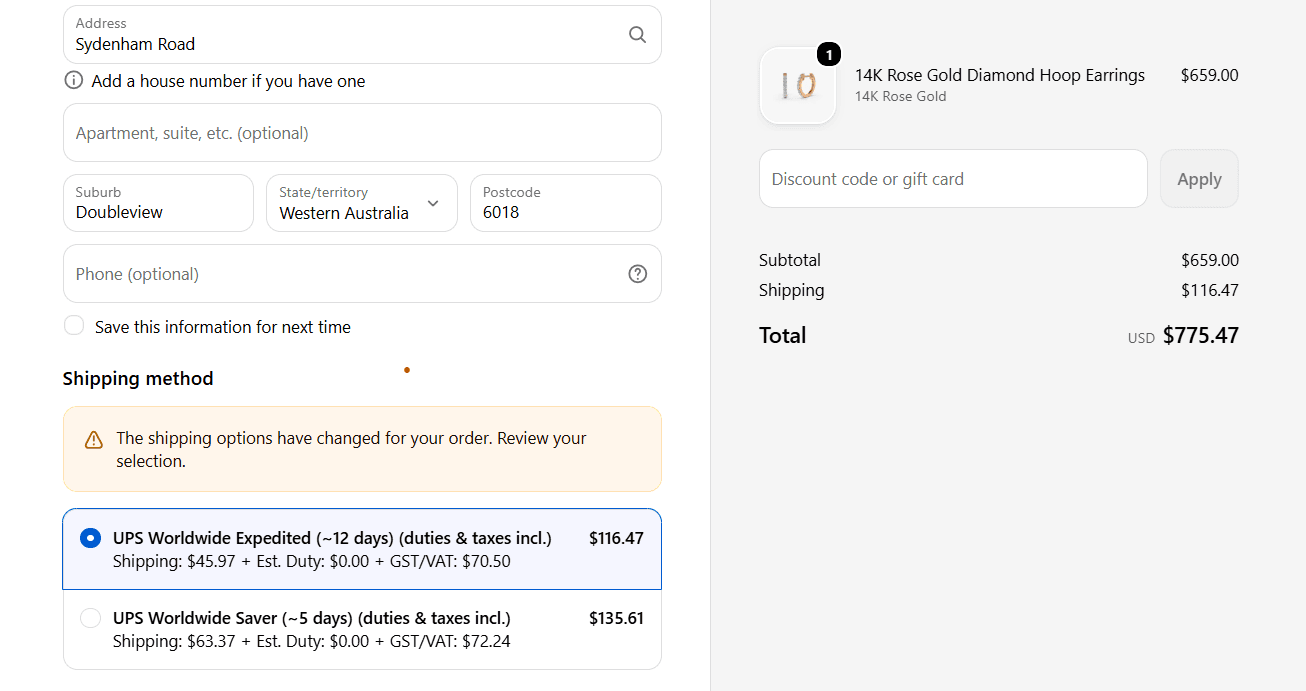
Show duties & taxes at checkout on Shopify
Selling to UK customers? Show duty and 20% VAT at checkout so nothing is owed when the carrier arrives.
Install on ShopifyRateTell Team
RateTell helps Shopify merchants show estimated duties, taxes, and shipping at checkout. Start for free today.
Start for FreeRelated articles
Countries
Canadian Import Duties: Complete Guide for 2026
How Canadian import duties work — CBSA tariff schedules, duty rates, de minimis thresholds, and how to calculate duties for shipments to Canada.
Countries
Customs Charges in Ireland: How Much & How to Pay [2026]
How much are customs charges in Ireland? Import duty, VAT, and carrier fees explained — plus how to pay customs on packages to Ireland.
Countries
EU Import Duty: Rates, VAT, and How to Pay [2026]
EU import duty explained: how the EU charges import duty and VAT, current rates, de minimis rules, and how to pay customs charges.