How to Set Up International Shipping on Shopify
You can set up international shipping on Shopify in six steps: turn on Shopify Markets, add shipping zones and rates, choose DDP or DAP, handle duties and taxes, show the landed cost at checkout, and test with a real order. Here is the full sequence.
Localized storefront
Sell in the customer's currency and language per market with Shopify Markets.
Real shipping rates
Set flat, weight-based, or carrier-calculated rates for every destination.
Accurate duties and taxes
Classify each product with an HS code so duty and import tax estimates hold up.
One final price at checkout
Show the full landed cost before payment so nothing is owed on delivery.
1. Enable Shopify Markets
Start in Shopify admin under Settings, then Markets. Shopify Markets is Shopify's built-in internationalization feature. Turning it on lets you choose the countries you sell to and set currency, language, pricing, and domains for each one, so shoppers see a localized storefront instead of your domestic version.
You can start with a handful of high-demand markets and expand later. Markets localizes the storefront, but it doesn't set your shipping rates, and duty calculation depends on your plan — native on Advanced/Plus, end-to-end with Managed Markets, or a third-party app on lower plans. Those are configured separately, which is why the next steps matter. For the bigger picture of how the pieces fit together, see our Shopify international shipping guide.
2. Set Shipping Zones and Rates
Go to Settings, then Shipping and delivery, and create a zone for each market or country. A zone groups destinations that share the same rates. Inside each zone, add your rates: a flat rate is simple, weight-based rates scale with heavier orders, and carrier-calculated rates bill the real postage from UPS, FedEx, or DHL.
Match the rate to the destination rather than using one flat worldwide price, or far-away orders will lose you money. Remember that shipping charges are only part of what the customer owes — duties and taxes stack on top, and they are calculated separately.
3. Decide DDP vs DAP
DDP (Delivered Duty Paid)
- You collect duty and tax at checkout and clear customs
- Customer pays one final price and owes nothing on delivery
- No surprise fees, so fewer abandoned cross-border carts
- Price the duty in when you set your rates
DAP (Delivered At Place)
- You pass the bill to the buyer
- Buyer pays the carrier before the parcel is released
- Keeps your listed price lower but adds surprise bills
- Higher cart abandonment and refused deliveries
The stakes are higher now that the US suspended its $800 de minimis exemption in August 2025, so almost every US-bound order owes duties and taxes. Read the full DDP shipping explained breakdown before you pick a side.
4. Handle Duties and Taxes
Duties and taxes come from three inputs: the product's HS code, its country of origin, and the destination country's rules. Add each product's HS code and origin in Shopify, then estimate the duty and import VAT or GST per destination. Get the HS code wrong and the estimate is wrong, so classification quality matters more than the tool you use.
Low-value thresholds have changed recently and are easy to get wrong. There is no active US $800 de minimis allowance — it was suspended in August 2025. The EU now applies a flat €3 duty per item type on parcels up to €150 (from July 2026), the UK exempts duty under £135, and Canada uses CAD 20 by mail, CAD 40 by courier, and CAD 60 for gifts by mail. Estimate a specific product with our Shopify landed cost calculator, or compare the tools that automate classification and collection in the best apps for international shipping.
5. Show the Landed Cost at Checkout
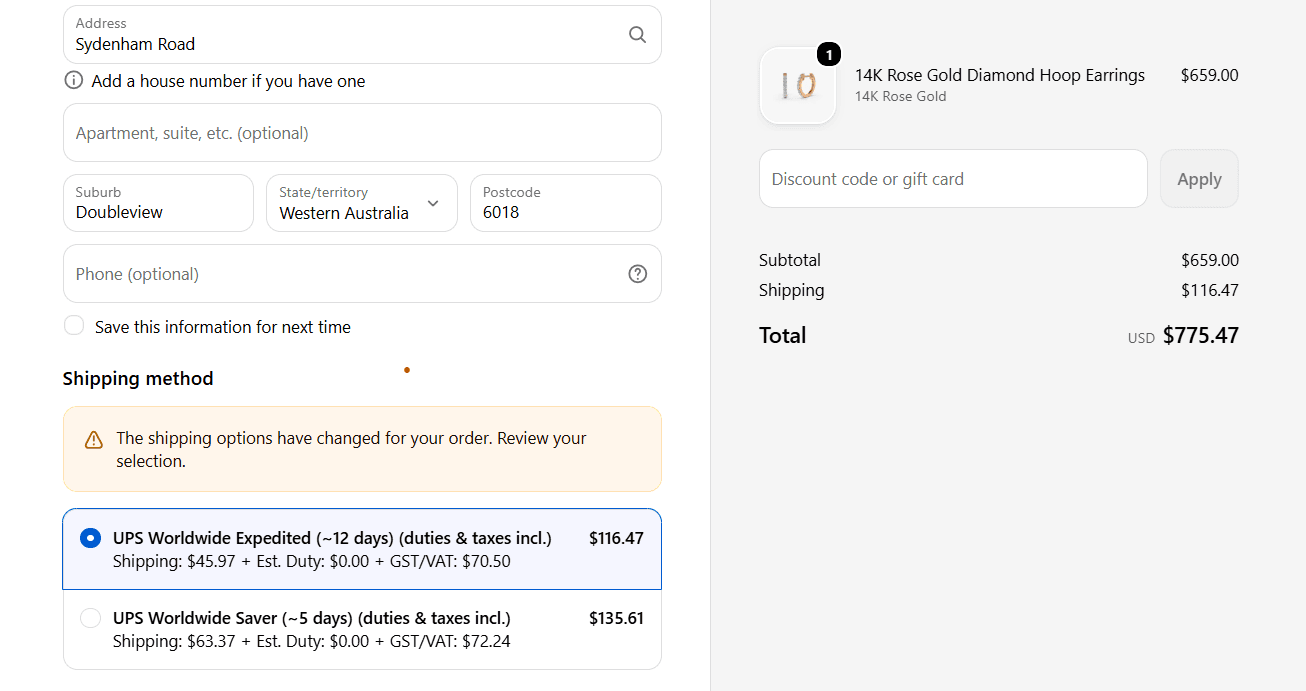
Landed cost is the product price plus freight, insurance, duty, and import tax. Show that single number at checkout and the customer makes one informed decision instead of bracing for a courier invoice. Shopify can estimate duties and import taxes natively on eligible plans when you supply HS codes, and third-party apps calculate a guaranteed landed cost in the customer's local currency.
Whichever route you take, the goal is the same: no charges owed after payment. See how that works in practice in our guide to showing duties at checkout.
6. Test With a Real International Order
Do not launch on assumptions — place a real test order. Ship to an address in one of your new markets, using a live carrier rate and a product with a known HS code. Check that the shipping rate, duty estimate, and total shown at checkout match the customs documents generated with the order.
Then track the parcel through delivery and confirm the customer owes nothing more if you chose DDP. A test order exposes wrong zones, missing HS codes, and underpriced duties while they are still cheap to fix — before real customers, and real refunds, are involved.
Frequently Asked Questions
How much does it cost to ship internationally on Shopify?
It depends on the carrier, the destination, and the parcel's weight and dimensions. Shopify itself does not set or include international postage — you pay your carrier's rate and then either build it into what you charge or pass it to the customer. Add duties and import taxes on top, because most countries now charge them even on low-value orders.
Does Shopify calculate international shipping and duties automatically?
Shopify can calculate and collect estimated duties and import taxes at checkout on eligible plans (Advanced/Plus, or end-to-end via Managed Markets) when you supply accurate HS codes and country of origin; lower plans typically need a third-party app. Many merchants add a landed-cost app for guaranteed estimates. Either way, accuracy depends on correct HS classification and current destination rules.
What is the difference between Shopify Markets and Shopify shipping zones?
Shopify Markets controls where you sell and how prices, currency, language, and domains appear in each country. Shipping zones control what you charge for delivery to those countries. You need both — Markets shapes your storefront per market, and shipping zones and rates set the delivery cost at checkout.
Should I offer free international shipping on Shopify?
Free shipping can lift conversion, but it does not remove duties and import taxes, which still apply on delivery unless you pay them under DDP. If you advertise free shipping, price the landed cost into your product or set a minimum order value. Otherwise a free order can still arrive with a customs bill, which frustrates customers.
How do I add customs information to my Shopify products?
Add each product's HS code and country of origin in your Shopify product settings under the customs or shipping section. Shopify uses those fields to estimate duties and generate accurate customs forms. If either one is wrong, the duty estimate is wrong and customs may reclassify the shipment.
Do I need an HS code to ship internationally from Shopify?
Yes. Every commercial cross-border shipment needs an HS code for customs clearance and duty calculation. Without one, the carrier may assign a code for you or hold the parcel. You can look up the code yourself or let an app classify each product automatically.
Want to automate classification and landed cost instead of configuring everything by hand?
Compare Shopify apps for international shippingShow the Full Cost at Checkout
Give international shoppers the final price — duties and taxes included — before they pay.
Learn more: Shopify International Shipping · Show Duties at Checkout · DDP Shipping