Customs Duty Rates: How Much Will You Pay?
Customs duty is usually 0-25% of the declared value — but the exact rate depends on your product's HS code and destination country. Estimate yours in seconds below.
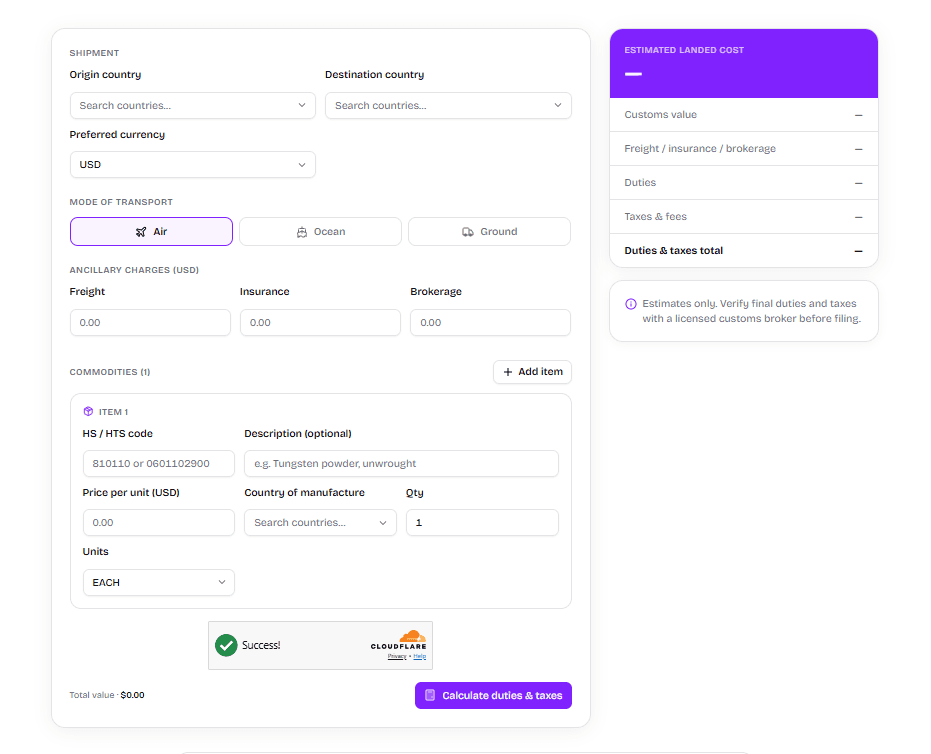
Estimate your duty rate
Typical Duty Rates by Category
Duty rates cluster by product category, and knowing the typical range for your goods gives you a quick reality check before you get an exact number. These are rough guides, not quotes — the precise rate always comes from your HS code and destination country.
| Category | Typical duty rate |
|---|---|
| Electronics | 0-2% |
| Textiles & apparel | 5-12% |
| Footwear | 8-20% |
| Furniture | 2-8% |
| Cosmetics | 2-7% |
| Auto parts | 2-6% |
Electronics like phones and laptops are often duty-free or near it, while apparel and footwear are among the most heavily protected categories in nearly every market. The ranges above hold for most developed countries, but your exact rate can differ sharply depending on where you ship and what trade agreements apply.
How Rates Are Set
Every duty rate is the product of three things: the product's HS code, the destination country's tariff schedule, and the country of origin. First, your product gets a 6-digit Harmonized System code that all countries share. Each country then extends that base and publishes its own rate for every line — the US in the HTS, the EU in TARIC, the UK in the UK Global Tariff.
Finally, trade agreements can override the standard rate entirely. A product made in a country with a free trade agreement (like USMCA or the EU's deals) can enter at a preferential or zero rate, provided you certify the origin. The same product from a non-treaty country pays the full rate. For the step-by-step math, see our guide to how to calculate import duties.
Duty Is Just the First Layer — VAT Comes On Top
Your final bill is a stacked calculation, and duty is only one layer. Most countries charge import VAT (or GST/HST) on top of the goods value plus shipping plus duty — so the tax base grows as each layer is added. With a 5% duty and 20% VAT, a $100 product ends up costing $126 in tax-paid terms, not $125.
The formula is roughly: (goods value + freight + insurance + duty) × VAT rate. Duty is often the smaller charge — VAT and similar taxes frequently add 15-25% on top. Walk through the full math in our guide on calculating import duties and taxes, or if you're new to the topic, start with what are customs charges.
De Minimis: When You Pay Nothing
Most countries waive duty and taxes on low-value shipments below a de minimis threshold — the UK exempts duty under £135, and Canada under CAD 20 (by mail) or CAD 40 (by courier), with gifts by mail exempt up to CAD 60. The EU replaced its €150 exemption in July 2026 with a flat €3 duty per item type on parcels under €150 (temporary, until its new customs data hub launches around 2028). The US suspended its $800 threshold in August 2025 — every commercial US-bound shipment now requires customs entry and pays applicable duties and taxes regardless of value.
These thresholds apply to the goods value, not the total cost including shipping, and they can change. If your order stays under the limit, you may owe nothing at all — if it crosses it, the full rate applies to the entire value.
Who Actually Pays?
Customs duty is a tax on the importer — the buyer is legally responsible for it. In practice, though, who pays depends on the sales terms. Under DDP, the seller covers duty and taxes; under DAP or FOB, the buyer picks up the bill, often via courier charges on delivery. Before you quote a price, know which side you're on: it can swing your total cost by 10-30%. See our full breakdown of who pays customs duties.
Frequently Asked Questions
Know Your Exact Duty Rate
Get a precise estimate for your product and destination — free.
Learn more: Duties & Taxes · Landed Cost · How to Find Your HS Code