US Customs Duty Calculator: Estimate Import Duties & Taxes
Free US customs duty calculator — estimate import duties and taxes on goods entering the United States. HTS rates, 2026 tariff changes, and the end of the $800 de minimis exemption explained.
July 13, 2026
A US customs duty calculator estimates the import duty and taxes owed on goods entering the United States — you enter your product's HTS code and declared value, and it applies the current US duty rate (typically 0-20%). With the $800 de minimis exemption suspended since August 2025, all commercial shipments now pay applicable duties and taxes regardless of value. Whether you're a Shopify merchant sourcing products from overseas or a buyer purchasing goods internationally, a duty calculator helps you price products accurately and avoid surprise charges before your goods even ship.
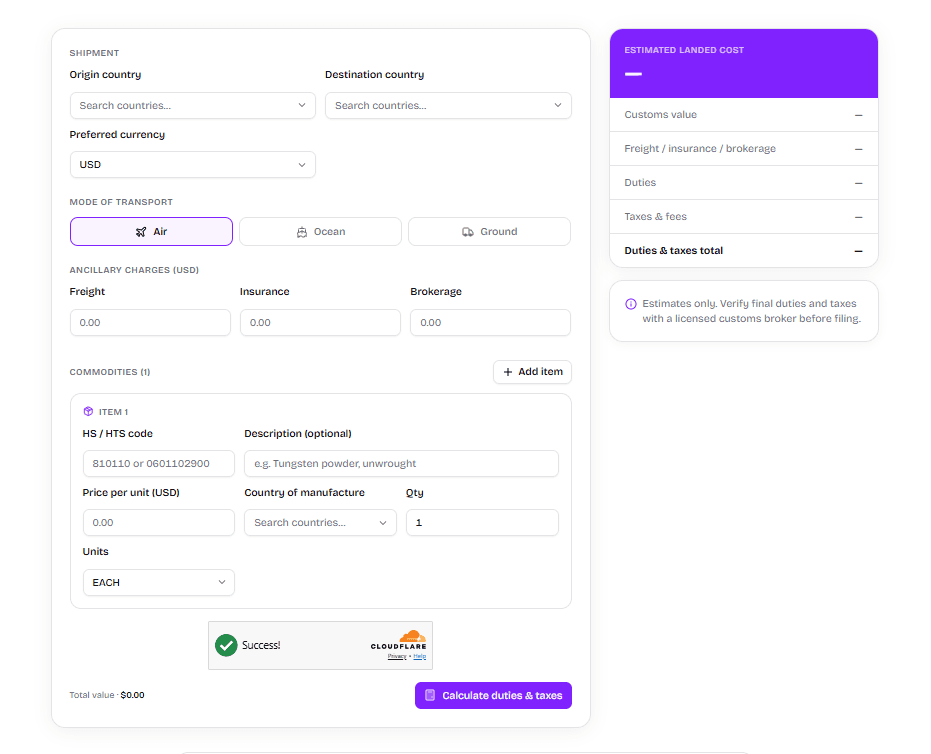
Try it now — our free duty and tax calculator estimates duties and taxes for 200+ countries.
How US Import Duties Work
US Customs and Border Protection (CBP) administers all import duties at the border. Every product entering the US is classified under a 10-digit code in the Harmonized Tariff Schedule of the United States (HTSUS). This code determines the duty rate applied to your shipment.
The HTSUS is based on the global Harmonized System (HS) maintained by the World Customs Organization. The first six digits are standardized worldwide, while the last four digits are specific to the US tariff schedule. Finding the correct HTS code is critical — misclassification can lead to overpaying duties or facing penalties from CBP.
Duty rates in the US are typically ad valorem, meaning they are a percentage of the product's customs value. The customs value is generally the transaction price — what you actually paid for the goods, including shipping and insurance to the US port of entry. Some products also face specific duties (a fixed amount per unit) or compound duties (a combination of both).
US De Minimis & Section 321: What Changed
For years, the US had one of the most generous de minimis thresholds in the world. Raised from $200 to $800 in 2016 and codified under Section 321 of the Tariff Act of 1930, it let low-value shipments clear customs free of duties and federal taxes. That changed in 2025: the exemption was suspended for China and Hong Kong in May, then for all countries on August 29, 2025.
The suspension means every commercial shipment to the US — regardless of value or origin — now requires a formal or informal customs entry and pays applicable duties and taxes. Shipments up to $2,500 can use an informal entry, while shipments above that require a formal entry through a licensed customs broker. Either way, the goods must be classified under the correct HTS code before duty can be assessed.
The old workarounds are gone too: merchants can no longer split orders into sub-$800 shipments to avoid duties. A statutory repeal of the exemption is scheduled for July 1, 2027, and litigation over the suspension continues — so treat the suspension as the current rule, not a temporary blip.
For merchants, the practical takeaway is simple: budget duties and taxes into every US-bound order's landed cost. Use the calculator below to estimate what you'll owe before you quote a price or set a checkout total.
How HTS Rates Work
The US uses the Harmonized Tariff Schedule of the United States (HTSUS), which extends the 6-digit international HS code to 8 or 10 digits. To find the right rate, you first locate your product's 6-digit HS base using our how to find an HS code guide, then extend it to the US schedule — see how to look up an HTS code for the full walkthrough.
Recent tariff updates have raised rates on certain categories, including electronics, auto parts, and steel and aluminum. Because schedules change, always check the current HTS before shipping rather than relying on rates you saw last year — the wrong rate can mean underpaid duties at entry or a surprise bill on delivery.
Duty + Merchandise Processing Fee
Duty is not the only cost on US imports. Formal entries also face a Merchandise Processing Fee (MPF) of approximately 0.3464% of the shipment's value, subject to a $31.67 minimum and a $614.35 maximum per entry. Ocean cargo may additionally be subject to the Harbor Maintenance Fee (HMF), a charge on the value of goods moved through US seaports. These figures are approximate — the published MPF schedule — so factor them into your landed-cost estimate alongside the duty rate itself.
US Duty Rates by Product Category
US duty rates vary widely depending on the product type and its HTS classification. Here are some common categories and their typical rate ranges:
- Clothing and apparel: 10–20% — one of the most heavily taxed categories
- Electronics: 0–6% — many consumer electronics enter duty-free under the Information Technology Agreement (ITA)
- Footwear: 10–37% — rates depend heavily on material and construction type
- Cosmetics and skincare: 0–6% — varies by formulation and packaging
- Home goods and furniture: 0–8% — generally moderate rates
- Jewelry and watches: 5–11% — precious metals and stones have specific classifications
- Toys and sporting goods: 0–8% — many toys enter at low or zero rates
These ranges reflect general patterns, but the exact rate depends on the specific 10-digit HTS code. Two similar products — say, leather dress shoes vs. rubber-sole sneakers — can have dramatically different duty rates.
How to Use a US Custom Duty Calculator
A duty calculator eliminates the guesswork. Here's how to get an instant estimate:
- Find your HTS code. Use the product description or the HS code finder tool to identify the correct 10-digit HTS code for your product. Accuracy here is essential — a wrong code gives a wrong rate.
- Enter the product value. This is the declared customs value — the price paid for the goods. Do not include shipping costs separately; the calculator handles this.
- Select the country of origin. Where the product was manufactured (not where it shipped from) determines whether preferential rates from trade agreements apply.
- Get your instant breakdown. The calculator returns the applicable duty rate, duty amount, any applicable taxes, and the total landed cost.
For Shopify merchants, integrating a duty calculator at checkout means US customers see the full cost upfront — no surprise bills from customs on delivery.
US Trade Agreements and Duty Reductions
The US has trade agreements that reduce or eliminate duties for goods from specific countries. Understanding these can save you significant money on imports:
- USMCA (United States-Mexico-Canada Agreement): Replaced NAFTA in 2020. Eliminates or reduces duties on goods manufactured in Mexico and Canada, provided they meet rules of origin requirements. This is the most impactful trade agreement for North American e-commerce.
- Generalized System of Preferences (GSP): Provides duty-free treatment for eligible products from over 100 developing countries. GSP expired in 2020 but has been periodically renewed — check the current status before relying on it.
- Bilateral free trade agreements: The US has FTAs with countries including Australia, South Korea, Israel, Singapore, Chile, Colombia, and others. Each has specific product coverage and rules of origin.
To claim a preferential rate, you typically need to provide a certificate of origin or other documentation proving the product qualifies under the agreement. Simply shipping from a qualifying country is not enough — the product must be substantially manufactured or transformed there.
Related guides: What is a Customs Duty Calculator? · How to Estimate Import Duties · Harmonized Tariff Schedule Guide
Calculate US import duties now with our free US custom duty calculator. Enter your HTS code and product value to get an instant landed cost breakdown.
Frequently Asked Questions
How much is US import duty?
Duty depends on the product's HTS code and origin; typical rates are 0-20% of declared value. The $800 de minimis exemption has been suspended since August 2025, so all commercial shipments pay applicable duties and taxes regardless of value.
What is the US de minimis threshold?
The US suspended its $800 de minimis threshold on August 29, 2025. All commercial shipments to the US now require a formal or informal customs entry and pay applicable duties and taxes regardless of value.
How is US import duty calculated?
Duty is calculated as customs value × HTS duty rate, plus a Merchandise Processing Fee on formal entries. The calculator above works out the duty automatically by HS code and country.
RateTell Team
RateTell helps Shopify merchants show estimated duties, taxes, and shipping at checkout. Start for free today.
Start for FreeRelated articles
Duties & Taxes
How to Estimate Import Duties Online — Free Calculator [2026]
Learn how to estimate import duties online using HS codes and destination country tariffs. Free import duty calculator with instant itemized breakdown.
Tools
What is a Customs Duty Calculator? How It Works [2026]
A customs duty calculator estimates import duties and taxes for international shipments. Learn how it works, what inputs it needs, and why every merchant needs one.
Duties & Taxes
Ireland Import Duty & VAT Rates: A 2026 Guide
Ireland import duty and VAT rates explained — EU Common Customs Tariff, 23% Irish VAT, de minimis thresholds, and worked calculations.