Commodity Code: What It Is & How to Find Yours [2026]
What is a commodity code? Learn how commodity codes work for international shipping, how they relate to HS codes, and how to find the right code for your products.
July 13, 2026
Every product that crosses an international border needs a commodity code. This numeric identifier tells customs authorities what the product is, how much duty to charge, and whether any trade restrictions apply. For merchants expanding into international markets, understanding commodity codes is essential for accurate pricing and smooth customs clearance.
A commodity code is the number customs uses to classify your product — the 6-digit HS code is global, while countries add extra digits (8-10) to pin down the exact duty rate and tax treatment.
What is a Commodity Code?
A commodity code is a standardized numeric code used to classify products for customs, trade statistics, and regulatory purposes. When goods arrive at a country's border, customs officials use the commodity code to identify what the product is and determine the rules that apply to it.
The term "commodity code" is used interchangeably with several other names depending on the country and context. You may also see it called an HS code, tariff code, customs code, or product classification code. At their core, all of these terms refer to the same concept: a numeric system for categorizing goods that move across borders.
The foundation for all commodity codes is the Harmonized System (HS), an international standard maintained by the World Customs Organization (WCO). Over 200 countries use the HS as the basis for their tariff schedules, making it the most widely adopted trade classification system in the world.
Commodity Code vs HS Code
While the terms are often used interchangeably, there is a subtle difference between a commodity code and an HS code. An HS code is the internationally standardized 6-digit code that every country agrees on. A commodity code is the broader, generic term that can refer to HS codes or to country-specific extensions of HS codes.
Here is how the terms are used in practice:
- HS code — The universal 6-digit code recognized worldwide. The first two digits identify the chapter, the next two identify the heading, and the last two identify the subheading.
- Commodity code (UK) — In the United Kingdom, "commodity code" specifically refers to the 10-digit code used by HMRC. This extends the 6-digit HS code with four additional digits for UK-specific tariff classification.
- Commodity code (general) — In other contexts, "commodity code" is a generic label that covers any level of the classification hierarchy, from the 6-digit HS code to the full national tariff code.
In short, every HS code is a commodity code, but not every commodity code is a 6-digit HS code. When someone asks for your product's commodity code, they are usually asking for the full national code for their country — not just the HS code.
How Commodity Codes Work
Customs authorities around the world rely on commodity codes to administer international trade. When your shipment arrives at the border, the commodity code determines several critical outcomes:
- Duty rates — The commodity code maps directly to a duty rate in the destination country's tariff schedule. A cotton t-shirt (HS 6109.10) may carry a different duty rate than a polyester t-shirt (HS 6109.90), even though both are shirts.
- Trade restrictions — Certain commodity codes trigger import licenses, quotas, or prohibitions. Products like firearms, pharmaceuticals, and agricultural goods often have additional regulatory requirements tied to their code.
- Trade statistics — Governments use commodity codes to track import and export volumes, monitor trade balances, and compile economic data.
- Preferential treatment — Free trade agreements often reduce or eliminate duties for specific commodity codes traded between member countries. The correct code ensures you claim any available preferential rates.
Declaring the wrong commodity code can have serious consequences. If the code results in a lower duty rate than what is owed, customs may assess back duties, penalties, and interest. If the code results in a higher rate, your customers pay more than necessary. Either way, incorrect codes slow down customs clearance and erode trust with buyers.
How to Find Your Commodity Code
Finding the correct commodity code for your products does not have to be difficult. Here are four approaches, from fastest to most thorough:
- Use RateTell's AI-powered lookup tool — RateTell's commodity code finder analyzes your product title and description to suggest the most accurate HS code. It then maps the code to country-specific commodity codes for your destination markets.
- Search your country's tariff database — Most governments publish their tariff schedules online. The US has the Harmonized Tariff Schedule (HTS), the EU has TARIC, and the UK has the Trade Tariff service. These databases let you search by keyword or browse by chapter and heading.
- Consult a customs broker — Licensed customs brokers specialize in tariff classification and can provide binding rulings for complex products. This is the safest option for high-value goods or products that could fall under multiple categories.
- Check with your shipping carrier — Carriers like FedEx, UPS, and DHL often require commodity codes on shipping documents and may provide classification guidance as part of their brokerage services.
Whichever method you choose, always verify that the commodity code matches the specific product you are shipping. A code for a plastic toy will not apply to a metal toy, even if they look identical to the end customer.
Commodity Code Examples
The same product can have different commodity codes depending on the destination country. The table below shows how a cotton t-shirt is classified across four major markets:
- International (HS) — 6109.10 (6 digits, universal)
- United States — 6109.10.0020 (10-digit HTS code)
- European Union — 6109.10.00 (8-digit TARIC code)
- United Kingdom — 6109.10.0010 (10-digit UK Global Tariff code)
Notice that the first six digits are identical across all countries. This is the internationally agreed HS code. The additional digits are country-specific extensions that provide finer classification for duty rate and regulatory purposes.
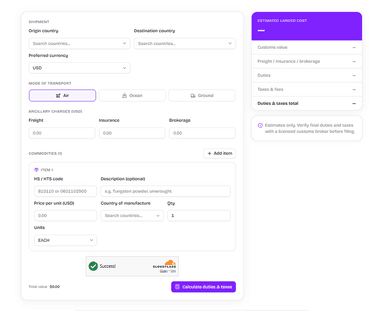
Try the free duty & tax calculator
Got your commodity code? Enter it with a destination country to calculate the exact duty and tax it will owe.
Calculate duty & tax nowFrequently Asked Questions
What is a commodity code for shipping?
A commodity code is a numbered classification that identifies exactly what a product is for customs purposes. The 6-digit HS code is international; the UK and EU extend it to 8-10 digits (CN/TARIC codes) to determine the precise duty rate and VAT treatment for your shipment.
What is the difference between a commodity code and an HS code?
An HS code is the internationally agreed 6-digit classification recognized by every country. A commodity code is the broader term — it can mean the 6-digit HS code or the longer country-specific version (8-digit TARIC in the EU, 10-digit in the UK and US) that adds detail for duty rates and regulatory rules. Every HS code is a commodity code, but not every commodity code is an HS code.
How many digits is a commodity code?
The international HS code is always 6 digits. Country-specific commodity codes extend it: the EU uses 8-digit TARIC codes, the UK uses 10-digit codes, and the US uses 10-digit HTS codes. The extra digits refine the classification for duty rates, VAT treatment, and trade measures.
Where do I find my commodity code?
Search your destination country's official tariff database — the UK Trade Tariff on GOV.UK, the EU's TARIC database, or the US HTS on hts.usitc.gov — by product keyword or description. Your supplier or freight forwarder can also provide the code from their shipping paperwork. AI-powered lookup tools that classify from a product title are the fastest way to get a verified code.
Do I need a commodity code for every shipment?
Yes — customs requires a commodity code on the commercial invoice for every international shipment, and carriers like DHL, FedEx, and UPS ask for it when you create a label. Shipments without a valid code are typically held for review, which delays delivery. Low-value parcels may clear under a simplified declaration, but the code is still required.
Related guides: What is an HS Code? · Tariff Code Guide
Find your commodity code with our free commodity code lookup tool. AI-powered classification with instant results.
RateTell Team
RateTell helps Shopify merchants show estimated duties, taxes, and shipping at checkout. Start for free today.
Start for FreeRelated articles
Classification
HS Codes Explained: A Merchant's Guide to Product Classification
What HS codes are, how they work, and why accurate classification matters for international e-commerce. Learn the 6-digit format and how to find the right code.
Classification
Tariff Code: What It Is & How to Find Yours [2026]
What is a tariff code? Learn how tariff codes work, how they differ from HS codes, and how to find the right tariff code for your products. Free lookup tool included.
Classification
What is an HS Code? Complete Guide to Harmonized System Codes [2026]
What is an HS code? Learn how Harmonized System codes work, how they're structured (6-digit format), and why they matter for international shipping and customs.